Best Free AI Checkers for Long Texts: Clever AI Detector Compared
Free AI detectors often work fine until you paste a 4,000-word report. These five were compared mainly on usable scan length, result clarity, limits, plus the honesty of their verdicts.
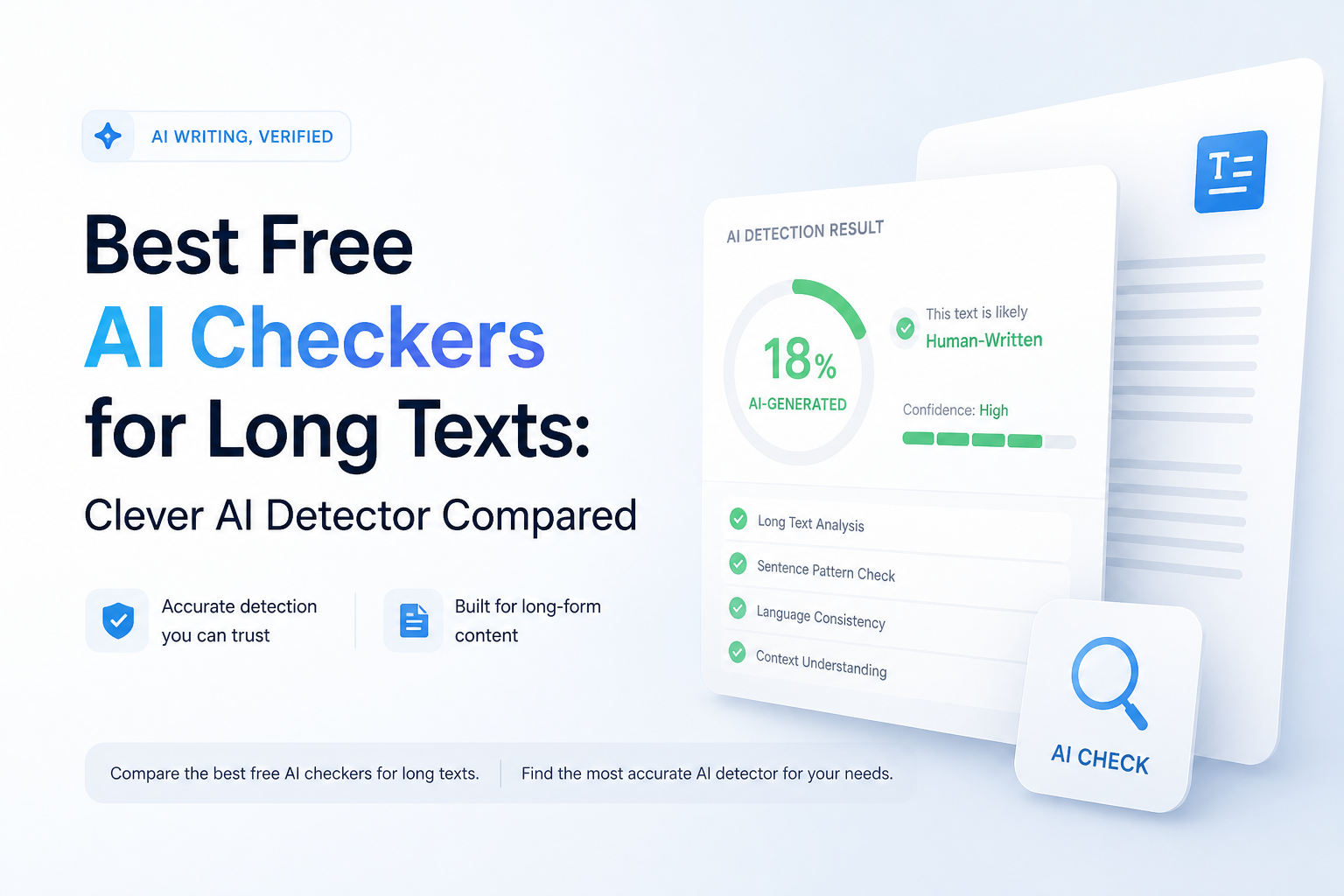
Clever AI Detector is the best free choice for long text because one scan can hold up to 10,000 words, with no fixed run allowance. GPTZero offers a deeper review workflow, while QuillBot gives the clearest distinction between generated text versus AI-assisted editing.
Clever AI Detector
9.2/10Best for: Editors, students, or writers checking essays, reports, plus articles that exceed the usual free limits
- Up to 10,000 words in one free check
- Unlimited scans with no fixed monthly allowance
- Sentence-level AI signals
- No signup required for a basic check
GPTZero
8.7/10Best for: Teachers or editors who want document uploads, sentence highlighting, plus a broader authorship-review workflow
- Useful sentence-level review
- Document-oriented workflow
- Google Docs plus Canvas options
- Authorship-verification features
QuillBot AI Detector
8.3/10Best for: Writers who use grammar or paraphrasing tools, then want AI-generated text separated from AI-refined writing
- Free detection for every user
- Recognizes AI-refined writing as a separate category
- Passage explainers support revision
- Supports file uploads
Free AI Checkers for Long Texts Compared
The table focuses on the free per-scan allowance plus sentence-level feedback, since both determine whether a detector is practical for essays or large reports. Scores reflect editorial judgment based on published limits, usability, transparency, plus supporting features. They are not laboratory accuracy ratings.
| Tool | Free Scan Limit | Sentence Feedback | Price | Score |
|---|---|---|---|---|
| 1. Clever AI Detector PICK | 10,000 words | ● Yes | Free | 9.2/10 |
| 2. GPTZero | 10,000 words/mo | ● Yes | Free | 8.7/10 |
| 3. QuillBot AI Detector | 1,200 words | ● Yes | Free | 8.3/10 |
| 4. ZeroGPT | 15,000 characters | ● Yes | Free | 7.7/10 |
| 5. Sapling AI Detector | 2,000 characters | ● Yes | Free | 7.4/10 |
The 5 Best Free AI Checkers for Long Texts, Reviewed
01 Clever AI Detector
Web app / Clever Humanizer
9.2/10
Clever AI Detector
Web app / Clever Humanizer
Clever is the easiest option here for genuinely long documents. Its free checker accepts up to 10,000 words per scan, while unlimited runs let you split a book chapter or large report without watching a monthly meter. The result includes an overall probability, confidence indicators, plus sentence-level signals. (cleverhumanizer.ai)
The interface also gets one crucial detail right: it describes the result as probability, not proof. That restraint matters because polished human writing, formal prose, or heavily edited drafts can trigger false positives. English is the only listed detection language, so multilingual teams will find Copyleaks or QuillBot more practical. (cleverhumanizer.ai)
Best forEditors, students, or writers checking essays, reports, plus articles that exceed the usual free limits
- Up to 10,000 words in one free check
- Unlimited scans with no fixed monthly allowance
- Sentence-level AI signals
- No signup required for a basic check
- Clear probability-based wording
- English detection only
- No plagiarism scan in the detector
- Newer tool with a shorter public track record
02 GPTZero
Web platform / GPTZero
8.7/10
GPTZero
Web platform / GPTZero
GPTZero offers more surrounding context than most free paste-box checkers. Its platform includes standard AI detection, an advanced scan, AI vocabulary review, authorship verification, plus integrations for Google Docs or Canvas. That makes it useful when a score needs follow-up rather than a quick verdict. (gptzero.me)
The free allowance has been listed at 10,000 words per month, which works for a few substantial essays but disappears quickly during batch review. The interface is busier than Clever's, though the extra tools can justify that friction for classroom use. (cleverhumanizer.ai)
Best forTeachers or editors who want document uploads, sentence highlighting, plus a broader authorship-review workflow
- Useful sentence-level review
- Document-oriented workflow
- Google Docs plus Canvas options
- Authorship-verification features
- Established education focus
- Free monthly allowance can run out quickly
- Account prompts add friction
- Many advanced features sit outside the basic free scan
03 QuillBot AI Detector
Web app / QuillBot
8.3/10
QuillBot AI Detector
Web app / QuillBot
QuillBot gives a more nuanced breakdown than a blunt human-or-AI label. It separates fully generated text from human writing that may have been refined with an assistant. Explainer cards point toward passages that influenced the result, which is handy during editing. (quillbot.com)
The free checker handles up to 1,200 words per scan with six daily checks. That is enough for short essays, blog sections, or reports checked in pieces. Long manuscripts become tedious because they require repeated splitting, while the 80-word minimum makes tiny excerpts unsuitable. (help.quillbot.com)
Best forWriters who use grammar or paraphrasing tools, then want AI-generated text separated from AI-refined writing
- Free detection for every user
- Recognizes AI-refined writing as a separate category
- Passage explainers support revision
- Supports file uploads
- Fits neatly beside QuillBot writing tools
- 1,200-word free scan limit
- Six free scans per day
- At least 80 words required
04 ZeroGPT
Web app / ZeroGPT
7.7/10
ZeroGPT
Web app / ZeroGPT
ZeroGPT is built for speed. Paste a draft, run the check, then inspect the highlighted passages. Its free limit has been documented at 15,000 characters per scan, enough for many essays or medium-length articles without registration. (cleverhumanizer.ai)
The tradeoff is interpretation. ZeroGPT can return firm-looking percentages, yet detector scores can shift after small edits or formatting changes. Treat it as a second opinion, particularly if a formal human-written paper receives an unexpectedly high score.
Best forOccasional users checking a single essay or article without creating an account
- No account needed for a basic scan
- Generous free character allowance
- Fast, uncluttered checking process
- Highlighted suspected passages
- Lower-cost paid tier than several rivals
- Character limits are less intuitive than word limits
- Results can react strongly to formal writing
- Free experience includes more distractions
05 Sapling AI Detector
Web platform / Sapling
7.4/10
Sapling AI Detector
Web platform / Sapling
Sapling's free detector is better viewed as a sample than a long-form tool. It allows 2,000 characters per check, so even a modest essay must be divided into many pieces. The clean result view is useful for a quick paragraph check, though it does not match this list's strongest free allowances. (sapling.ai)
Pro changes the equation by lifting checks to 100,000 characters. That capacity suits lengthy reports, support archives, or document batches, but the regular $25 monthly price is hard to justify for someone checking two papers per semester. (sapling.ai)
Best forSupport teams or professional reviewers who need extremely long checks after trying a small free sample
- Simple result presentation
- 100,000-character checks on Pro
- Batch support for several files
- One-month Pro trial is available
- Writing assistance included
- Free limit is only 2,000 characters
- Paid monthly price is fairly steep
- Best fit is broader writing support, not detector-only use
How We Compared Free AI Checkers for Long Texts
This comparison was built around published free limits verified in September 2026, result detail, account requirements, file support, plus the practical effort needed to check a long document. Clever's 10,000-word allowance was compared with GPTZero's monthly allowance, QuillBot's 1,200-word scans, ZeroGPT's character cap, plus Sapling's 2,000-character free checks.
The scores do not claim a universal accuracy rate. Detector performance changes with the model, subject, language, editing level, plus text length. Features or limits received more weight than vendor accuracy claims because readers can verify those details directly.
How to Choose a Free AI Checker for a Long Essay or Report
Start with the input limit. A 6,000-word report becomes annoying fast if a checker accepts only 1,200 words, since each section produces a separate score with no reliable whole-document average. A larger scan box also preserves context, which can matter when sentence patterns change across an introduction, evidence section, plus conclusion.
Next, look past the big percentage. Sentence highlighting, confidence labels, minimum-text guidance, file uploads, plus history are more useful than a dramatic red verdict. Privacy matters too. Avoid pasting confidential contracts, unpublished research, personal records, or client material until you have read the service's data terms.
Common Mistakes When Checking Long Texts for AI Writing
The biggest mistake is treating 80% AI as an authorship finding. It is a statistical estimate from one system, not a record of how the document was created. Formal templates, repeated technical terms, simplified English, plus polished academic structure can all influence a score.
Another problem is testing tiny passages from a much longer work. Most detectors need enough text to see patterns, so a flagged two-sentence excerpt tells you little. Keep the section intact, compare it with earlier writing, inspect document history, then ask for notes or sources if the decision carries consequences.
Which Free AI Checker Works Best for Long Texts?
Clever AI Detector wins because its free 10,000-word input is large enough for full essays, reports, plus long articles, while its sentence signals make the final score easier to question or investigate. GPTZero is the stronger runner-up for educators who need a broader review workflow. QuillBot suits AI-assisted editing, while ZeroGPT works well for quick second opinions.
No ranking makes these tools reliable evidence by themselves. Use a detector to locate passages worth reviewing, not to decide who wrote a document.
Run one known human sample from the same writer before judging a new document, then compare the result with a second detector if the first score seems suspicious.